Each week we’ll highlight one of the remarkable pieces held in our Repository—sharing its story, history, and the context that makes it special.
Week 3 - 11/15/2026
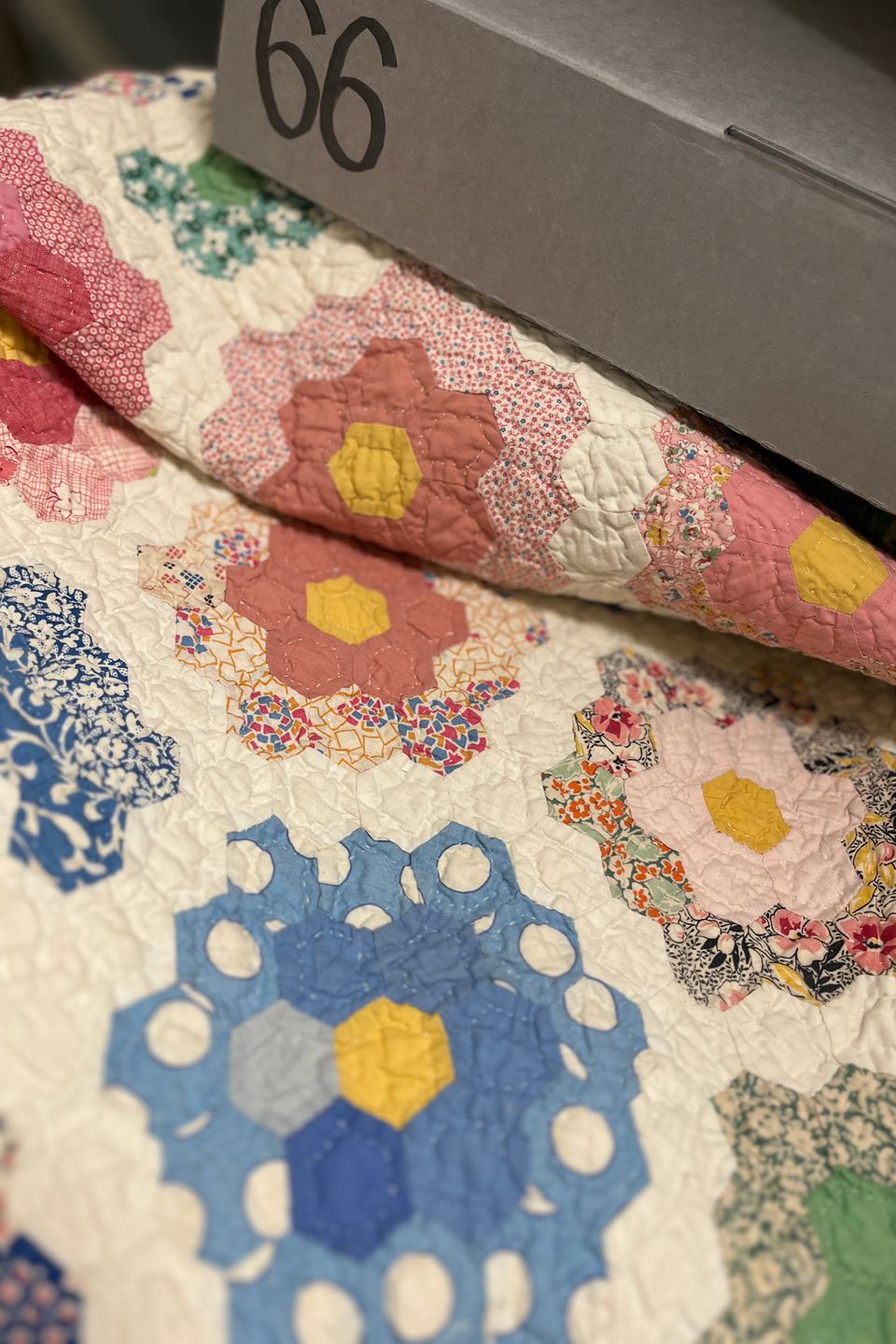
Grandmother’s Flower Garden Circa 1925–1940 | L.2001.137
Grandmother’s Flower Garden is one of the longest-lived and most beloved American quilt patterns. Its roots are English: the oldest known hexagon paper templates date to around 1770, and hexagon (“honeycomb” or “mosaic”) patchwork was already popular in England by the late 18th century. The design reached America by about 1800, and *Godey’s Lady’s Book* published the first printed American pattern with full English-paper-piecing instructions in 1835. Early names included Honeycomb, Mosaic, and Six-Sided Patchwork; during the Colonial Revival it was sometimes called Martha Washington’s Flower Garden. The name “Grandmother’s Flower Garden” only became widespread in the 1920s–1930s, the same period when Latimer’s quilt was made.
The construction method is English paper piecing. Fabric is basted over paper or thin cardboard hexagon templates, the covered hexagons are whip-stitched together by hand, and the papers are usually removed afterward. A typical “flower” consists of one center hexagon surrounded by six others, with additional rings sometimes added to enlarge it. Color placement turns the same simple shape into flowers, diamonds, or other motifs. Edges were often left jagged to follow the hexagons or trimmed straight with half-hexagons.
The pattern’s second great wave of popularity coincided with both the Colonial Revival and the hard years of the Great Depression. Quilts from this era frequently feature soft pastel prints drawn from feed sacks, worn dress fabrics, and leftover sewing scraps—materials that cost little or nothing at a time when money was scarce. Solid-color centers (often a bright yellow) and a contrasting “path” of hexagons between the flowers helped organize the mixed prints into a cheerful garden. The mix of fabrics visible on Latimer’s example is typical of the period’s thrifty, resourceful approach: every usable scrap found a place, and the finished quilt offered both warmth and a small splash of color during difficult times.
Week 2 | 11/8/2026
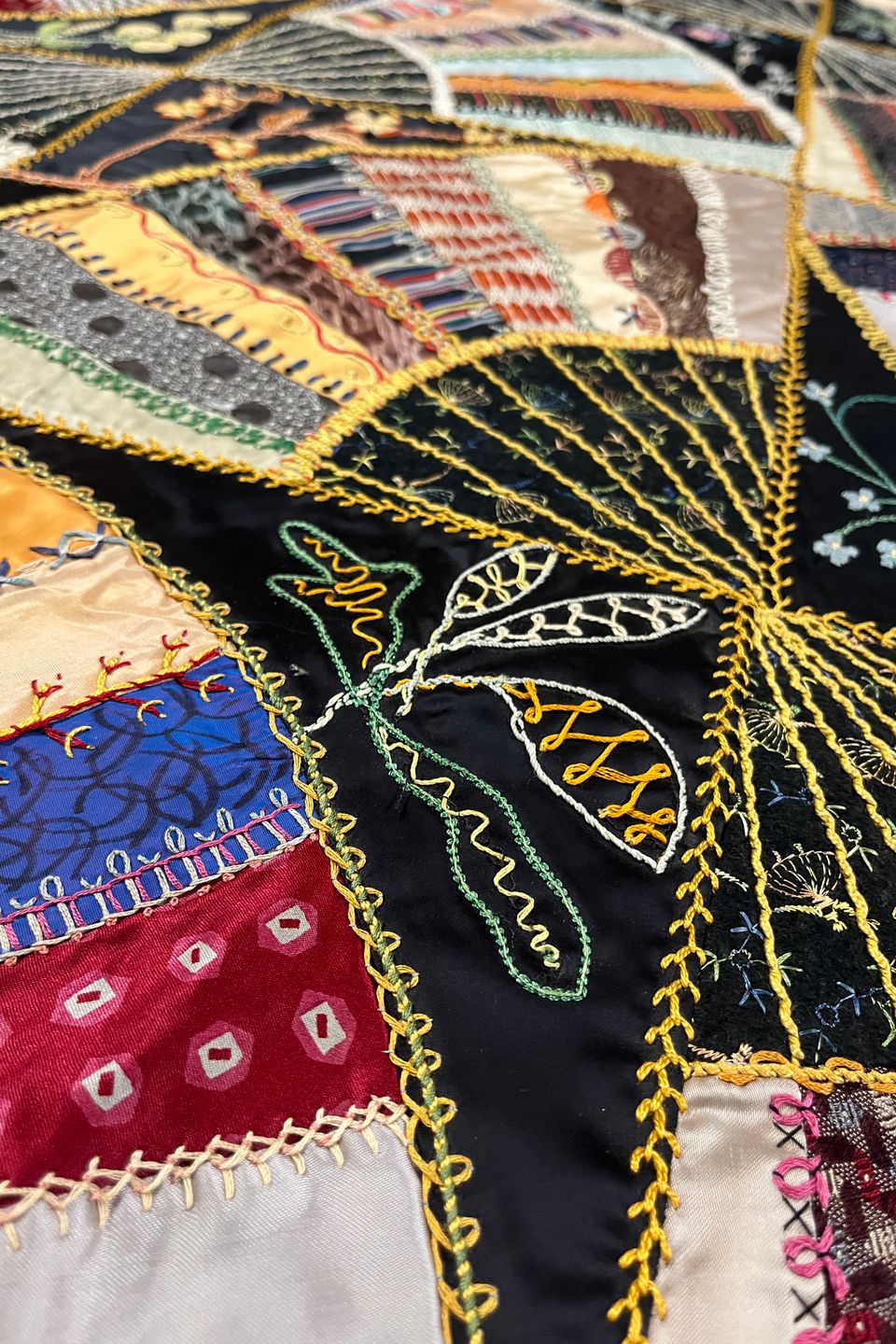
This spectacular crazy quilt, signed and dated by its maker Hazel Cobb-Bevans, is one of the treasures in Latimer Quilt & Textile Center’s collection.
Hazel Cobb-Bevans was a Tillamook County native who was born in 1895 and passed away on March 1983 according to public records. There is little public biographical details. If anyone knows some family history, we'd love to hear from you! This extraordinary piece of needlework—evidence of patience, skill, and a love of rich color and texture that still stops visitors in their tracks.
A quick look at crazy quilt history: Crazy quilts flourished in the late Victorian era, roughly the 1870s through the 1890s, though the style continued well into the 20th century. Unlike traditional pieced quilts built on repeating geometric blocks, crazy quilts are deliberately asymmetrical. Irregular scraps of silk, velvet, satin, and other “fancy” fabrics are stitched onto a foundation, then lavishly embroidered over the seams and across the patches with feathers, flowers, fans, animals, initials, and decorative stitches of every kind.
Several forces fueled the craze: The 1876 Centennial Exposition in Philadelphia introduced many Americans to Japanese design. - The asymmetrical, “crazed” look of Japanese ceramics and textiles influenced the random placement of patches. - Industrial silk production made luxurious fabrics more affordable. - Women’s magazines and silk manufacturers aggressively promoted the style, selling scrap kits and embroidery patterns.
These quilts were rarely intended for everyday use. Many were display pieces, status symbols, or keepsakes that showcased a woman’s needle skills. A fully embroidered crazy quilt could consume hundreds (sometimes more than a thousand) hours of work.
Week 1 - 11/01/2026
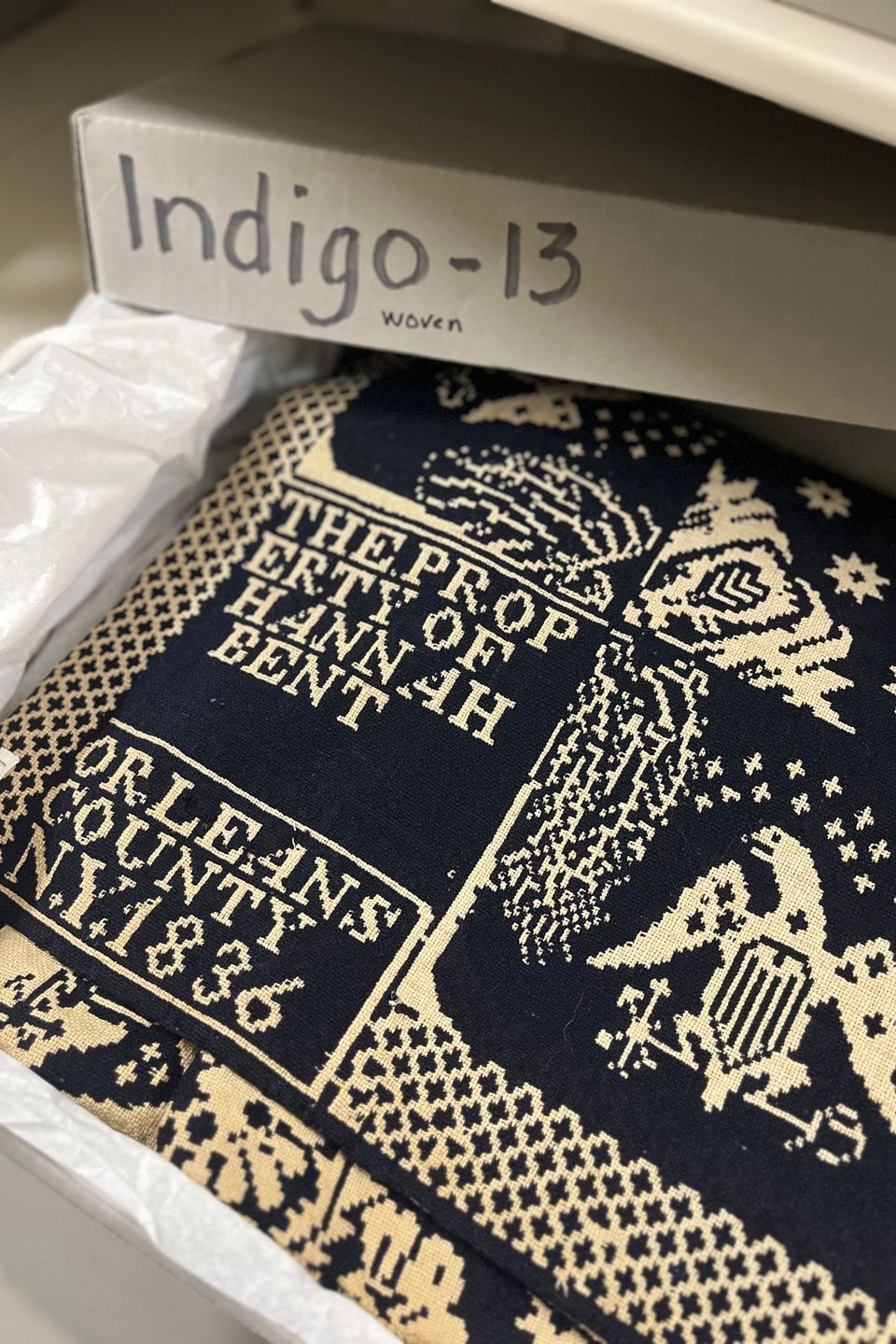
The Hannah Bent Coverlet, 1836 (Yes — it really is 190 years old!)
This handwoven Jacquard coverlet — indigo-dyed wool and natural cotton — was made for Hannah Bent of Orleans County, New York. In the 1830s, a professional weaver in western New York would take a client’s home-spun and dyed yarn, load a set of punched Jacquard cards onto the loom, and create these elaborate “figured and fancy” bedcovers. The weaver charged only for the labor; the yarn (and the personal inscription woven right into the cloth) belonged to the customer: “The Property of Hannah Bent, Orleans County N.Y. 1836”
Coverlets like this were far more than blankets. They were practical necessities for cold New York winters, status symbols that showed a family could afford specialized craftsmanship, and quiet declarations of American pride. The deep indigo-and-natural palette was the classic New York combination of the era. Stars, geometric borders, and stylized plants weren’t just pretty — they celebrated the young nation’s growing skill in manufacturing at a time when the Erie Canal had opened new markets and local industry was booming.
This is one of nearly 500+ artifacts carefully preserved in Latimer’s Repository. We are going to share another piece of textile history with you next week as a new series we're trying out. Let us know what you think!